



CASE 1107EX vs JCB VM117: Single-Drum Compactor Showdown
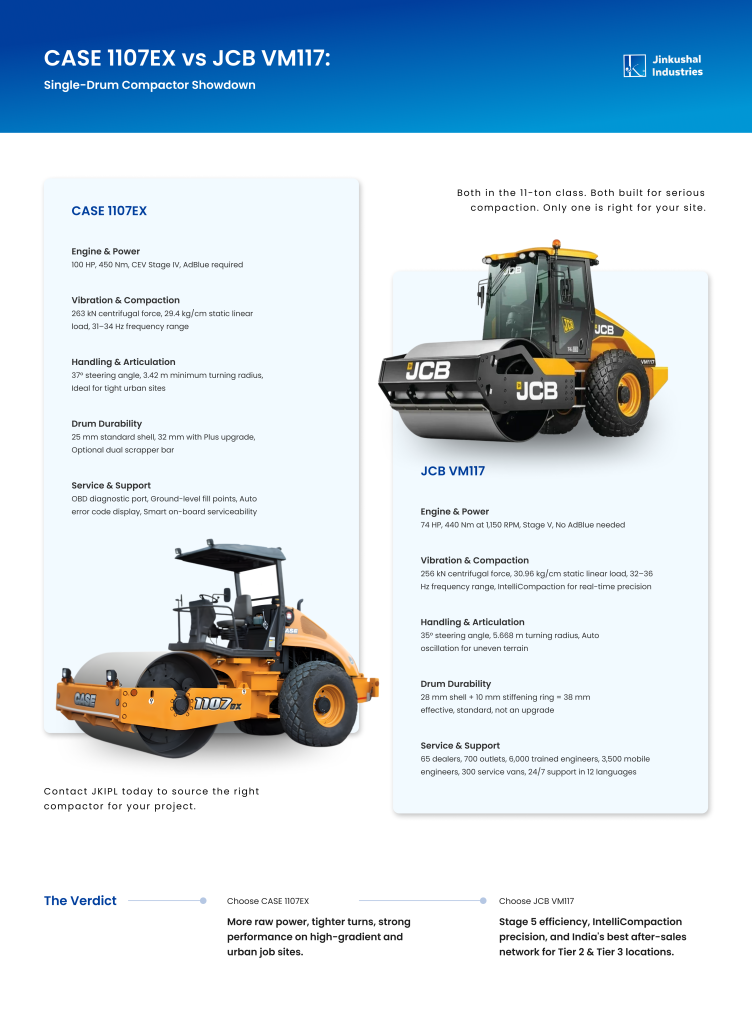
You are working on a road project & have to shortlist between two machines for a procurement decision to make. The Case 1107EX vs JCB VM117 is one of the most common debates among fleet managers and contractors, and for a good reason. Both compactors sit in the 11-ton class and are built for serious compaction capabilities.
Case brings a high-powered powertrain, proven articulation & highly durable build for demanding terrain, while JCB answers with modern features, more efficient engines & cutting-edge telematics, which keep connected to every machine in a fleet. This single drum compactor comparison breaks down both machines in 6 important parameters so that you can make a data-backed decision, not just relying on a brand.
CASE 1107EX vs JCB VM117: Power & Performance
Case 1107 EX
- AL H4 four-cylinder engine producing 100 HP & 450 Nm of torque
- Electronic common rail direct injection
- CEV Stage IV emission norms with AdBlue/DEF requirement
- Auto idle feature for up to 3% fuel savings during idle
- Turbocharged engine with internal EGR for optimised power delivery
JCB VM117
- JCB ecoMax four-cylinder engine producing 74 HP & 440 Nm at just 1,150 RPM
- Stage 5 emission norms with no AdBlue required
- 1,000 hours of fuel filter replacement interval
- IP-69 waterproof connectors for increased safety
Verdict: Choose the Case 1107 EX if you want raw horsepower. JCB, however, offers Stage 5 compliance, no AdBlue requirement & strong low RPM torque for better efficiency.
CASE 1107EX vs JCB VM117: Vibration System & Compaction Performance
CASE 1107 EX
- Dual vibration stages via a variable displacement pump
- 31 Hz high amplitude and 34 Hz low amplitude frequency
- Amplitude: 1.8 mm & 0.8 mm
- 263 kN maximum centrifugal force
- Static linear load: 29.4 kg/cm
- Variable amplitude enables flexible compaction across different soil depths
JCB VM117
- Single-shaft circular exciter with overturning weights
- Frequency: 32 Hz high amplitude & 36 Hz low amplitude frequency
- Amplitude: 1.8 mm and 0.8 mm
- 256 kN maximum centrifugal force
- Static linear load: 30.96 kg/cm
- IntelliCompaction system measures real-time compaction values, flags soft/hard spots, and avoids overcompaction
- Eliminates guesswork on tasks & projects with strict compaction specifications
Takeaway: The Case 1107 EX offers a higher centrifugal force, while JCB’s IntelliCompaction provides data-driven precision for improved compaction quality.
CASE 1107EX vs JCB VM117: Handling & Articulation
CASE 1107 EX
- Robust 4-point articulation joint for challenging applications
- Steering angle: 37 degrees each side
- Drum oscillation angle: 15 degrees
- Minimum turning radius: 3.42 metres
- Perfect for tight urban sites & confined construction zones
JCB VM117
- Servo-assisted centre articulation with automatic oscillation
- Steering angle: 35 degrees lock-to-lock
- Drum oscillation angle: 15 degrees
- Minimum outer turning radius: 5.668 metres
- Automatic oscillation for better drum-to-ground contact on uneven terrain
Verdict: Case offers better turning radius & handling, while JCB’s automatic oscillation gives it an edge on irregular surfaces.
CASE 1107EX vs JCB VM117: Drum Design & Durability
Case 1107 EX
- Standard EX model: Drum shell thickness of 25 mm
- 32 mm drum shell with Plus variant for heavier applications
- Heavy-duty frame with crossbar for better structural rigidity
- Optional dual scrapper bar for clean operation in slippery conditions
- Three models available: standard rear-wheel-drive (EX), drum drive (EX-D) for high gradients & pad drum model (EX-PD) for cohesive soils.
JCB VM117
Standard VM117 comes with a 28-mm heavy-duty drum shell
- An additional 10 mm stiffening ring (effectively 38 mm at reinforced sections)
- Single-piece solid eccentric shaft for optimised amplitude and frequency
- Drum designed with finite element analysis for structural strength
- 3-piece pad foot shell design or easy conversion to PD compactor
- Heavy-duty front frame for enhanced stability under heavy loads
Verdict: JCB’s reinforced drum offers a stronger build, which offers better durability on a variety of surfaces. While Case sells the Plus variant with a 32 mm shell, JCB’s stiffening ring comes as standard, not an upgrade.
CASE 1107EX vs JCB VM117: Serviceability, After-Sales & Dealer Network
Case 1107 EX
- Daily maintenance points are easily accessible (engine, hydraulic, & electrical components)
- Ground-filling points for diesel, hydraulic oil, and DEF/urea for reduced service turnaround time
- An OBD diagnostic port below the front console allows for quick technician access
- An automatic error code displayed directly on the cluster display
- An auto fan belt tensioner for extended maintenance intervals
- Modern radiator design improves engine durability over long operational hours
JCB VM117
- Full engine compartment access with a 70% wider rear bonnet
- An electronic feed pump to eliminate manual priming & prevent air entrance in the fuel line
- LiveLink for remote diagnostics, faster service & reduced downtime
- Lifetime-lubricated articulation joints & steering cylinders for maintenance-free design
- Digital visual warning system with error codes for better serviceability
- Best-in-class after-sales network (65 dealers, 700 outlets, 6,000 trained service engineers, 3,500 mobile service engineers)
- 300 service vans, 20 operator training centres, and 24/7 support in 12 languages
Verdict: Case focuses on offering smart, accessible & easy serviceability, plus modern on-board diagnostics. The JCB VM117, on the other hand, is untouchable with its unmatched service & availability network globally.
The Best Single Drum Compactor: The Winner?
After evaluating all the important specs and features that both single-drum compactors come with, it’s evident that there is no single winner in this single drum compactor comparison. Instead, the winner depends on your site & requirements.
Buy the Case 1107 EX if you need more power from the engine, work in tight urban sites and want strong performance on high-gradient terrains. The JCB VM117, on the other hand, shines in efficiency with its Stage 5 engines, IntelliCompaction function for compaction precision and best-in-class after-sales support & part availability, which matter for modern and challenging applications.

