



CAT 424 Vs JCB 3DX: Which Backhoe Loader Performs Better In 2026?
While shopping for a backhoe loader for your next project, the CAT 424 vs JCB 3DX debate may have already arisen. The Caterpillar 424 backhoe loader & JCB 3DX are among the best-selling backhoe loaders, and on paper, they look very competitive. Stage 5 engines, ROPS/FOPS operator cabs, durable hydraulics & advanced features, all offered at competitive price points.
Once you dig past the brochures, the differences become clearer. Power output, hydraulic flow, fuel tank size, loader capacity & digging depth; these gaps add up over a full shift, and even more so over a full year of operation. So, if you’re looking to buy a backhoe in 2026, wondering which machine to invest in, this blog provides you with clear answers, no marketing lectures, just facts that matter.
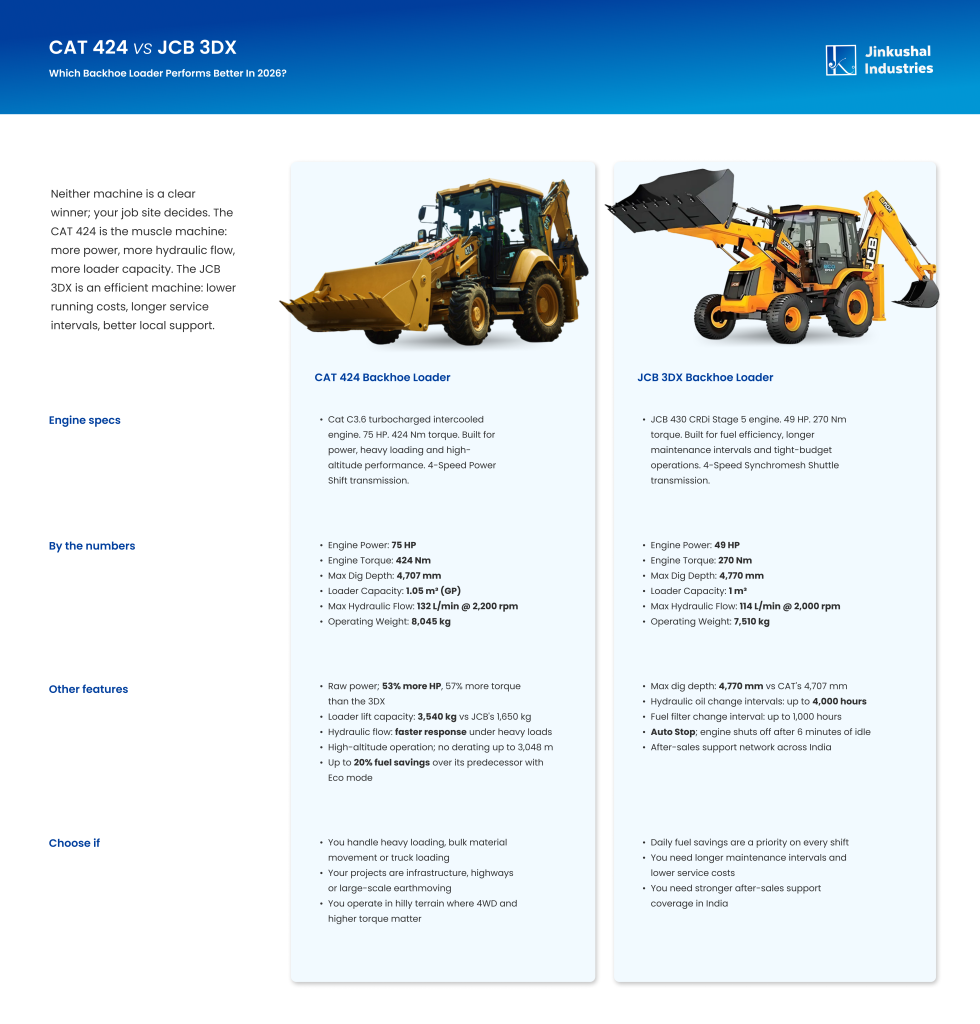
CAT 424 vs JCB 3DX: Specs At A Glance
| Specification | CAT 424 Backhoe Loader | JCB 3DX |
| Engine Power | 75 hp | 49 hp |
| Engine Torque | 424 Nm | 270 Nm |
| Max Dig Depth | 4,707 mm | 4,770 mm |
| Loader Capacity | 1.05m³ (General Purpose); 1m3 (Multi-Purpose) | 1m3 |
| Operating Weight | 8,045 kg | 7,510 kg |
| Max Hydraulic Flow | 132L/min @ 2,200 rpm | 114L/min @ 2,000 rpm |
| Transmission Type | 4-Speed Power Shift | 4-Speed Synchromesh Shuttle |
Engine Specs & Performance
In the CAT 424 vs JCB 3DX debate, the difference in engine specs is notable. The CAT 424 backhoe loader uses the Cat C3.6 turbocharged intercooled engine delivering 75 HP gross power and a max torque of 424 Nm. No de-rating is required up to 3,048 metres altitude, giving it an undeniable advantage in high-stress tasks. The engine is BS-V CMVR compliant & offers up to 20% fuel saving over its predecessor with the Eco mode.
The JCB 3DX packs the JCB 430 CRDi Stage 5 engine, making 49 HP & a peak torque of 270 Nm at just 1,320 rpm. While power & torque are significantly lower, the 3.0L engine is tuned for fuel economy, with a fuel filter change interval extended to up to 1,000 hours.
The Auto Stop feature shuts off the engine after 6 minutes of idle. For contractors doing standard excavation on flat terrain, the JCB’s efficiency-first approach has real daily cost advantages, but the CAT 424’s engine offers both efficiency & muscle.
Capabilities
For digging, the JCB 3DX stays ahead with a maximum dig depth of 4,770 mm compared to the CAT 424’s 4,707 mm. JCB also offers a wider ground-level reach of 6.72 m than the CAT’s 6.97 m from the rear axle centreline, with a maximum working height of 5.97 m. JCB’s bucket tearout force stands at 5,959 kgf, which is impressive for its class.
The CAT 424 backhoe loader offers better loader performance. It delivers a lift capacity at maximum height of up to 3,540 kg with the GP bucket, against JCB’s 1,650 kg. CAT’s loader breakout force reaches 53,212 N, & its maximum hinge pin height of 3,449 mm provides strong dump clearance. For heavy loading tasks like loading trucks, quarrying, handling rocks, or working through dense material, the CAT 422 offers compelling advantages.
Hydraulics & Manoeuvrability
The CAT 424 uses a closed-centre, variable-flow axial piston pump offering a capacity of 132 L/min at 2,200 rpm. System pressure is rated at 245 bars on both the rear backhoe & front loader circuits. This allows for faster speeds & better response under loads, which operators appreciate immediately when working on busy sites.
The 3DX’s hydraulic unit operates at 265.52 bar with a pump flow of 114 L/min at 2,000 rpm. Its paired with JCB’s Filtromatic return-line filter & hydraulic oil change intervals extended to 4,000 hours, lowering maintenance costs & providing better uptime.
From a turning radius perspective, both backhoes are well-matched. JCB’s loader bucket turning circle (inner wheels braked) is 8.64 m, while CAT measures 8.18 m outside front wheels. For tight urban sites, neither machine has a serious disadvantage, though the JCB’s independent foot pedals for tight manoeuvring give it a slight practical edge in sites with tight spaces.
Operator Cab Comfort, Safety & Technology
Both backhoe loaders meet the ROPS and FOPS cab standards, so operator safety in rollovers & falling object situations is covered on both choices. The CAT 424 backhoe loader provides an ergonomic suspension seat, a clear instrument cluster, improved cab mountings, & a hood that opens from inside the cab to prevent theft. CAT’s Product Link telematics is standard, offering fleet managers real-time access to machine hours, location, & utilisation data.
The JCB 3DX holds its ground with a walk-through two-door cab, an upgraded suspension seat, a tinted front windscreen for sun glare reduction, Bluetooth stereo for hands-free communication, & a wire-free throttle system supporting both hand & foot controls. An interior cabin light, front screen wiper, & high-power face fan are present as well.
JCB’s LiveLink telematics & IntelliDiagnostics system combines to transmit fault codes remotely before a service engineer reaches the site, reducing diagnostic downtime. IP69-rated waterproof electrical connectors increase long-term reliability on dusty & moist job sites.
Which Backhoe Loader To Buy?
In the CAT 424 vs JCB 3DX debate, neither machine is a clear winner in this comparison, as both are well-matched against each other. Your choice depends on what you actually need at a job site.
Choose The CAT 424 Backhoe Loader If:
- You handle heavy loading operations & bulk material movement.
- Your projects involve infrastructure, highways & large-scale earthmoving.
- Your machine operates in hilly regions or terrain where 4WD & higher torque output matter.
Choose The JCB 3DX If:
- Daily fuel savings are a priority.
- You’re looking for longer maintenance intervals & lower maintenance costs.
- You’re looking for better after-sales support in India.

