



Cat Wheel Loader or Cat Backhoe Loader: Which One Do You Need?
Wheel loaders & backhoe loaders are among the most popular pieces of equipment used in construction globally. While both look identical, they boast notable differences. Imagine yourself renting the wrong machine, which gulps large quantities of fuel, struggles to perform a specialised task onsite & ends up losing precious time at your worksite.
CAT construction equipment, while regarded as some of the best in many parts of the world, does inherit differences. Selecting between Wheel loaders & backhoes is a high-stakes choice as both machines are highly capable material movers.
Both machines wear the iconic Caterpillar badge, but in the duel of Wheel loader vs backhoe loader, the wrong choice leaves you with a machine that does half your job & struggles with the rest. You need the right equipment to protect your margins. Read this blog to learn which machine belongs on your project.
Introducing The Contenders
What Is A Wheel Loader?
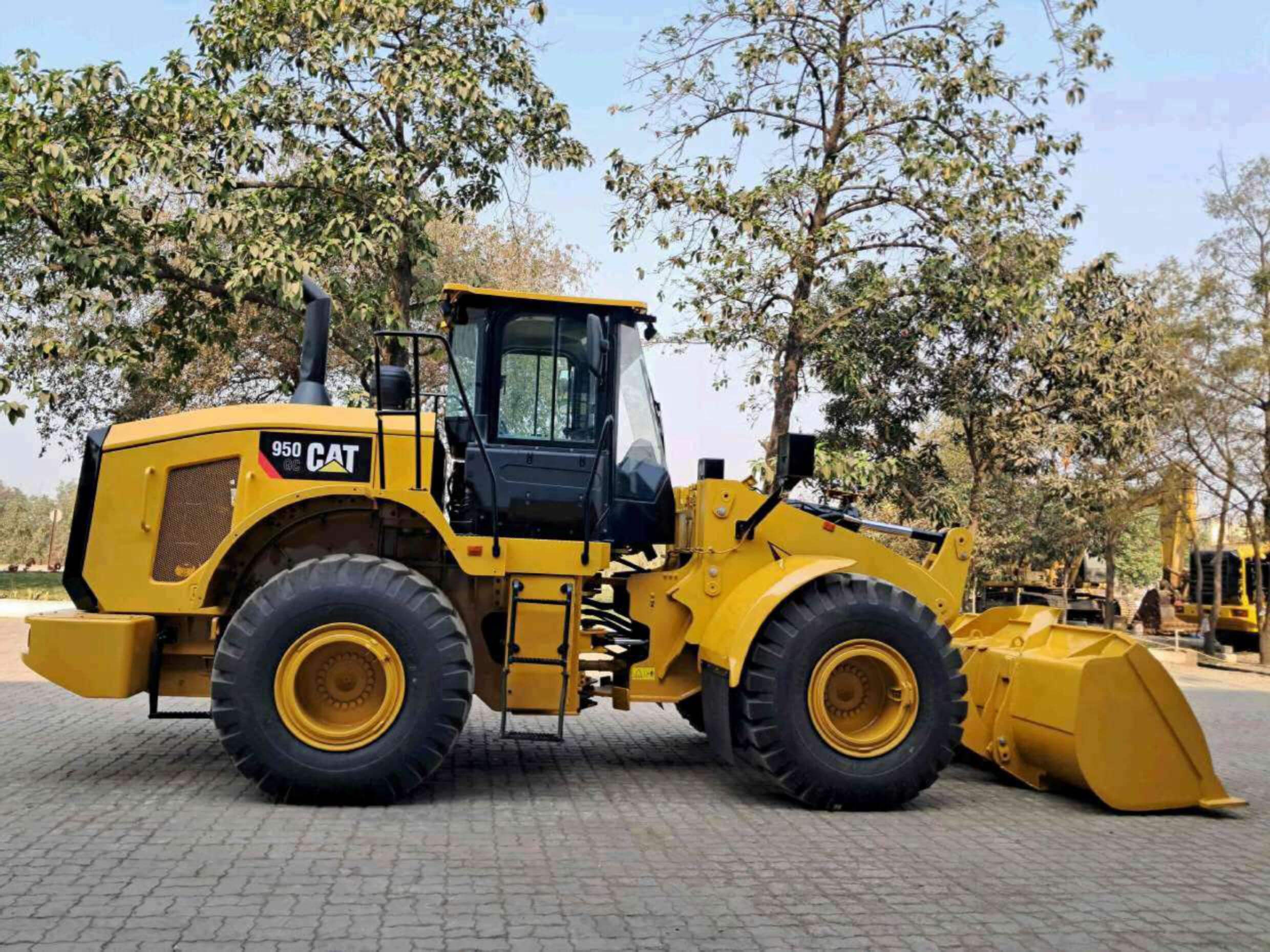
Wheel loaders are specialised heavy lifters engineered to carry large amounts of volume. They are designed with a massive front bucket, which is also why they are often called front loaders.
Machines like the CAT 950 loader are used for scooping, carrying, and dumping massive amounts of loose material. You rely on them when moving bulk quantities of construction aggregate or loading fleet trucks quickly is your primary goal.
Wheel loaders offer superior load-carrying capabilities, bucket capacities, and breakout forces compared to backhoe loaders. Their massive front-mounted buckets help to clear sites quickly. You benefit from raw muscle for demanding & high-volume tasks.
What Are Backhoe Loaders?
Backhoe loaders are the most popular piece of equipment used in construction globally. This machine is designed with a front loader & rear bucket, enabling it to lift, load, scoop, trench & dig, & almost any work you can imagine at worksites. Machines like the CAT 420 are highly popular, used for digging trenches, backfilling, preparing sites, loading & lifting.
However, they have a fair share of pros & cons. Backhoe loaders come with smaller standard loading buckets compared to wheel loaders. On the bright side, they offer better versatility through their front & rear arms, along with more attachments on offer, which we’ll discuss shortly.
Costing
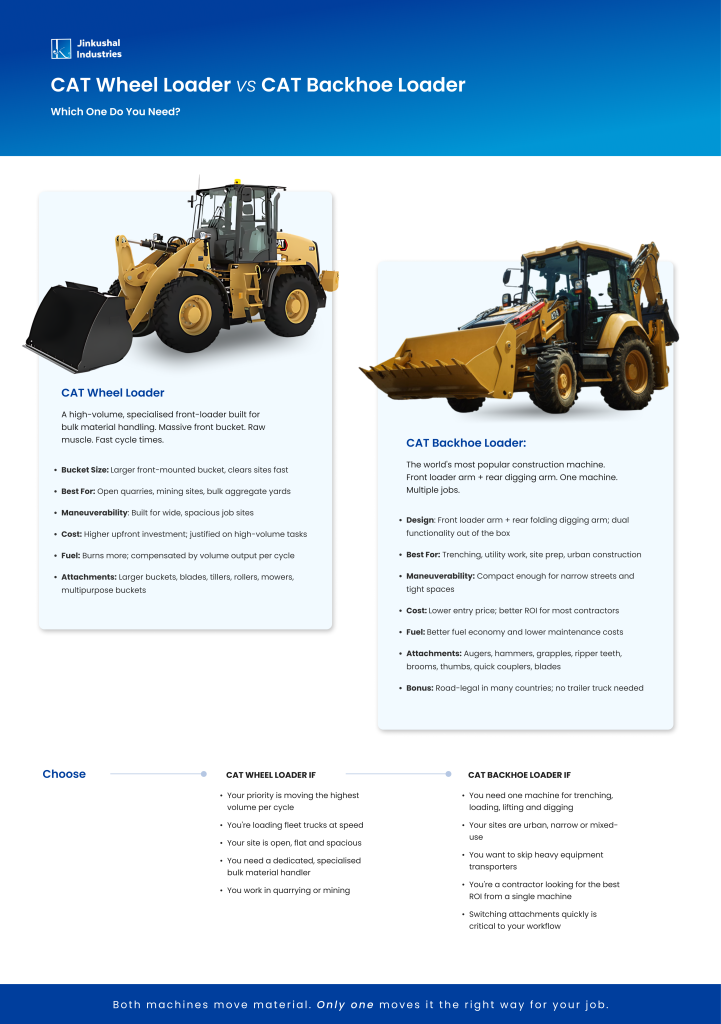
The initial financial investment will vary significantly between these two machines. Heavy-duty CAT wheel loaders generally cost more due to their massive structural size & higher power output. On the flip side, CAT backhoe loaders often cost less, offering a lower entry price for most buyers. However, the pricing depends on the model you’re buying.
This makes the backhoe an incredibly attractive option for independent contractors needing versatile equipment on a tight budget. You must weigh this price against daily usage.
Manoeuvrability Comparison
In your decision between choosing a wheel loader & a backhoe loader, your job site layout plays a major role in your procurement decision. Wheel loaders are large machines, which makes them ideal for wide, open quarries, but you’ll find it difficult to operate them in tight or congested spaces, especially in urban areas.
In contrast, Backhoe loaders are far more compact & also available in larger sizes, which makes them a better choice for urban sites, narrow streets, mixed-use zones, & even quarrying. In many countries, you can drive backhoe loaders like the CAT 420 to worksites, which reduces dependency on trailer trucks & reduces transportation costs.
Attachments Versatility Evaluation
When you look closely at the debate of wheel loader vs backhoe loader, versatility favours backhoes. A backhoe loader’s design, the front loader arm & rear folding arm, enables this machine to carry dual functionality right from a dealership. You can use the front loader bucket in a backhoe & a front loader to load, unload, lift, grade, compact & handle materials.
The rear folding arm in a backhoe loader comes with a standard, smaller bucket, used for digging, trenching, excavations & demolition. Both machines can be fitted with optional attachments for increased versatility. Wheel loaders & backhoe loaders can be fitted with larger buckets, tillers, rollers, clips, land levers, multipurpose buckets, blades, mowers, etc.
In contrast, CAT backhoe loaders can be equipped with larger rear buckets, augers, ripper teeth, hammers, grapples, thumbs, blades, quick couplers, brooms, & various other attachments. The increased attachment compatibility offers better versatility & makes a backhoe loader more compatible for mixed applications.
TCO Comparison
The sticker price is just your machine’s starting point. A CAT 950 loader is larger & more powerful. Thus, it burns more fuel & needs higher upfront costs. However, on tasks where you need muscle, it justifies every Rupee you spend.
On the other hand, the CAT 420 & CAT backhoes are more affordable. Not only that, this machine offers better fuel economy, requires less maintenance costs & above all, enables you to work on tasks across multiple industries with the capability of handling multiple tasks simultaneously. This helps you earn more with a backhoe loader & thus it offers a better ROI for many contractors.
When To Choose CAT Wheel Loaders?
- When your work includes quarrying, mining & moving bulk aggregates
- When more volume per cycle is your priority
- You’re looking to load trucks with fast cycle times.
- A job site is spacious, open & allows fast machine movement.
- You need a specialised material handler.
When To Choose CAT Backhoe Loaders?
- You require a machine for trenching, pipeline work & utility installations, alongside loading tasks.
- You need one machine that can perform various tasks.
- You don’t want to rely on heavy equipment transporters.
- You want a machine that offers the best ROI among the heavy equipment.
- A machine that can quickly switch between attachments

