



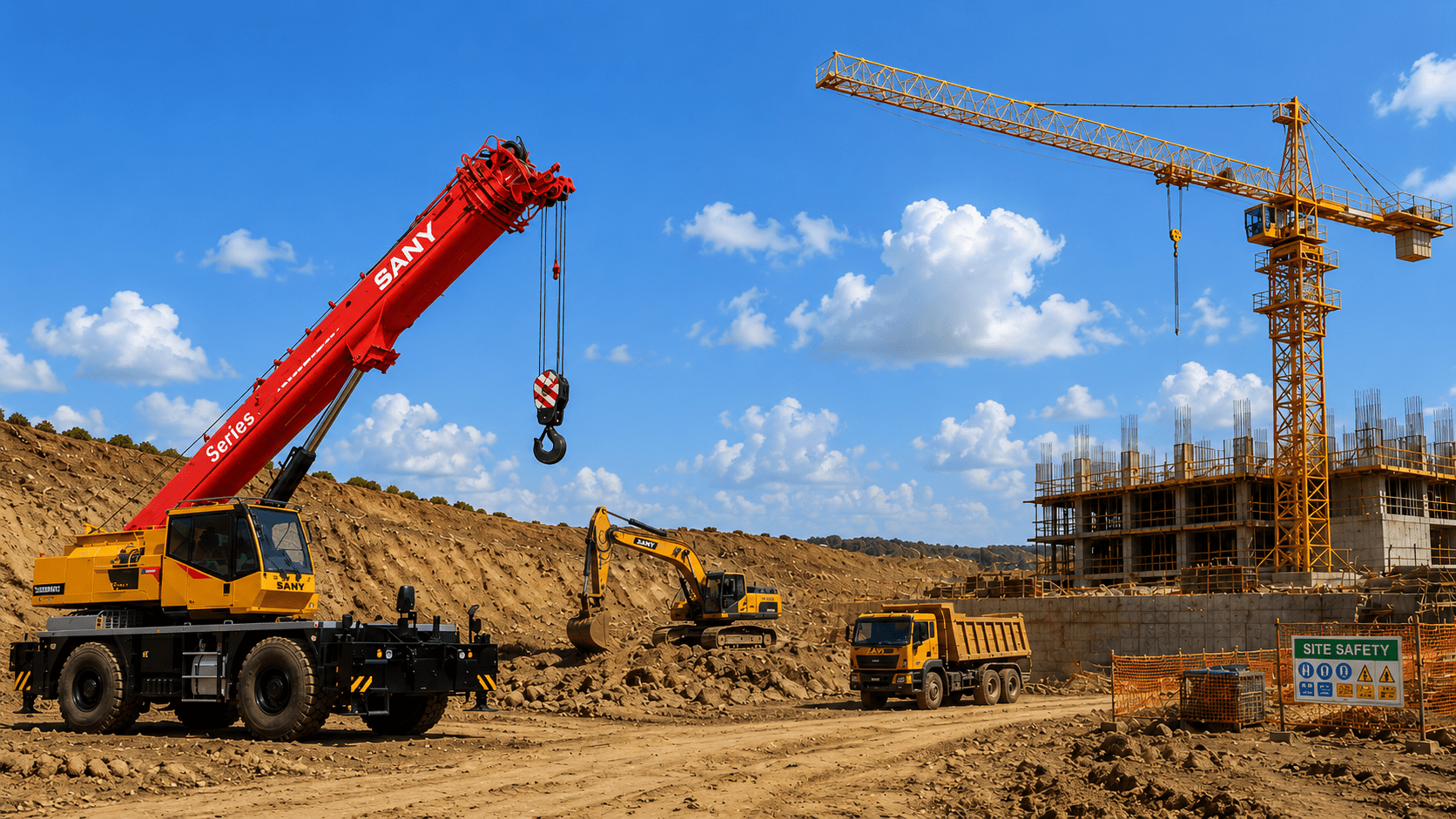
Tower Crane vs. Mobile Crane: Which One Do You Need for Your Project?
Selecting the right crane for a construction project is one of the most important decisions you have to make while planning a project. Choose a mobile crane & you get flexibility & fast setup. Go with a tower crane, and you get height, power, & strong lifting capacity. Both are highly reliable when it comes to equipment for lifting, but they work best in very different situations.
Buying the wrong crane means wasted money, delays, & added stress at work. The tower crane vs mobile crane debate often arises among construction project managers & contractors. But honestly, there isn’t a one-size-fits-all answer. Once you understand how each crane works & what each does best, the right choice becomes easier.
Understanding A Tower Crane & Mobile Crane: A Snapshot
A tower crane is a fixed structure, assembled at work sites & they are usually rooted to a concrete foundation. These cranes are designed for tall, large-scale construction projects, where strong vertical lifting capabilities are required over demanding projects. Tower crane setup takes time, typically several days to a week.
Once operational, they deliver exceptional height & load capacity with a smaller footprint at the surface level. These cranes are a staple on high-rise residential, commercial, & infrastructure projects.
On the other hand, a mobile crane is mounted on a wheeled or tracked carrier. This also makes it easy to switch between locations. These cranes need less preparation time & can operate within hours of arrival. The advantages of using a mobile crane include better site flexibility, faster deployment, & suitability for short-duration lifts.
Mobile cranes come in multiple configurations: truck-mounted, rough terrain, and all-terrain, which provide contractors with options based on site conditions.
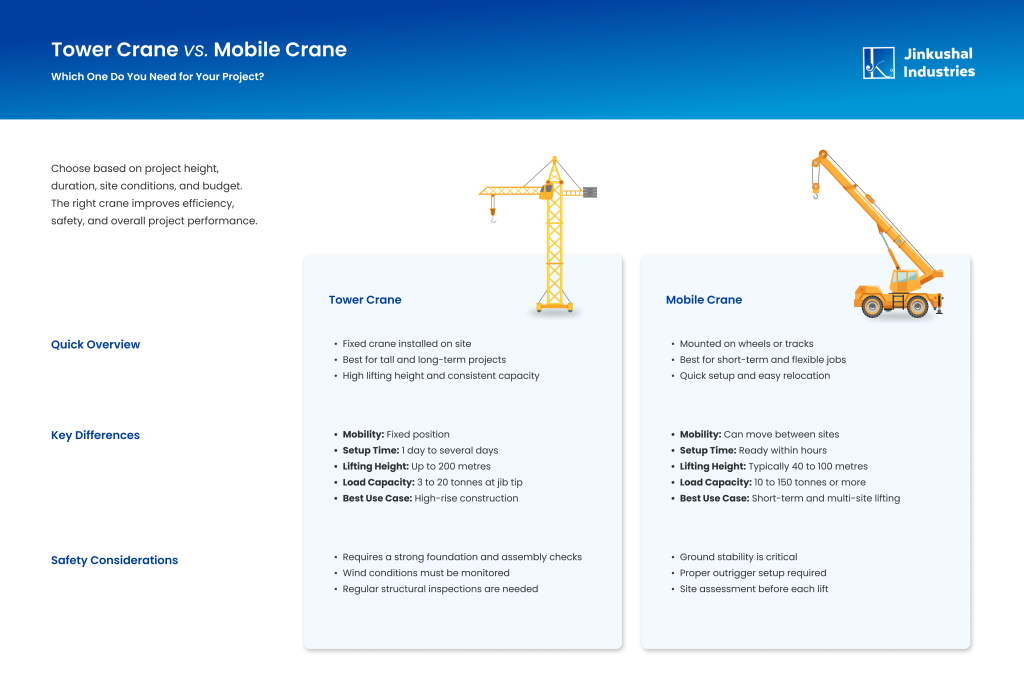
Tower Crane Vs Mobile Crane: Key Differences
A tower crane is rooted to a concrete foundation & cannot be relocated once assembled. It lifts heavy loads vertically along a fixed radius. Lifting heights range from 30 to 200 metres, depending on anchoring & configuration.
Standard cranes can handle loads between 3 and 20 tonnes at the jib tip. A tower crane setup for a small-to-medium crane typically takes 1 to 3 days, while larger models can take up to weeks.
A mobile crane depends on a hydraulic telescopic or lattice boom equipped on a wheeled or tracked carrier. Being simpler & smaller, this type of crane can be positioned, operated, & demobilised within a day. Most mobile cranes offer a lifting range between 40 and 75 metres, but certain models like Sany SAC2500S offer more than 100 metres of lifting height.
Standard hydraulic mobile cranes handle loads between 10 and 150 tonnes, but heavy-duty models can lift considerably higher. In the tower crane vs mobile crane comparison, key technical differences include: fixed height capacity versus ground-level mobility, and load range versatility.
Tower Crane Vs Mobile Crane: When To Use Each Equipment For Lifting?
Use A Tower Crane If:
1. Your project or task involves construction at heights (above 10 floors).
2. The project duration is more than 6 months.
3. The site has limited ground space for crane manoeuvrability.
4. You need high-capacity lifting power daily.
5. The project is located in an urban area & requires a smaller footprint.
Use A Mobile Crane When:
1. Your project is short-term & requires quicker turnaround times.
2. You require equipment for lifting across multiple locations.
3. Priorities include fast mobilisation & setup.
4. Site terrain is open & accessible for manoeuvrability.
5. Your project includes lifting heavy materials into low-rise buildings or structures.
Safety & Operational Efficiency Considerations
Both types of cranes require strict operational safety protocols, but they pose different risks. A tower crane must be inspected & maintained regularly for structural integrity, especially the mast & jib. Wind speed is a key operational factor & tower cranes are equipped with anemometers to alert operators when wind speed exceeds safe limits & stop work until conditions improve. Also, erecting a crane needs rigorous engineering checks, soil testing & assembly expertise.
Mobile crane operators, on the other hand, must assess a ground’s bearing capacity before each lift to avoid tipping & accidents. Operators must ensure the ground can support outriggers. Both machines demand certified operators & site-specific plans. Operational efficiency notably improves when the type of crane matches the type of work being done.
Cost Considerations
Budget constraints often determine the final decision between the two cranes. Renting a stationary crane requires high upfront costs; you have to pay for the initial transportation of parts, the complex assembly process, & the final dismantling. However, the daily operational cost becomes highly economical over a multi-year project.
In contrast, the financial advantages of mobile crane rentals include short-term affordability. You skip massive assembly & dismantling costs entirely. You only pay for the machine & it’s ready to lift materials. Always calculate your complete timeline & dynamic lift requirements before finalising your budget.
Conclusion
When it comes to choosing between tower & mobile cranes, there is no universal winner. Instead, it’s about the right choice. The right selection depends on a project’s height, duration, site conditions, & budget. Tower cranes are ideal for sustained, vertical & large-scale projects. Mobile units align with flexible, short-term & multi-location work.
Check your lift requirements carefully before committing to either choice. The right crane dictates productivity, efficiency, profitability & most importantly, site safety.

