



Why Refurbishment Standards Matter: Inside JKIPL’s Engineering-led QA Process
Introduction
The demand for refurbished construction equipment in India has grown at a very fast rate as the contractors are looking for reliable, cost-effective alternatives to new machinery. But the real worth of refurbished equipment depends entirely on the quality standards it has gone through.
Poorly refurbishing the used equipment can result in breakdowns, safety risks, and project delays whereas high-standard refurbishment can extend the life of that machine, improves performance, and becomes a long-term investment. For that, JKIPL has a dedicated engineering-led Quality Assurance (QA) process, backed by deep inspections, technical re-construction, and export-grade testing.
Why Refurbishment Standards Matter
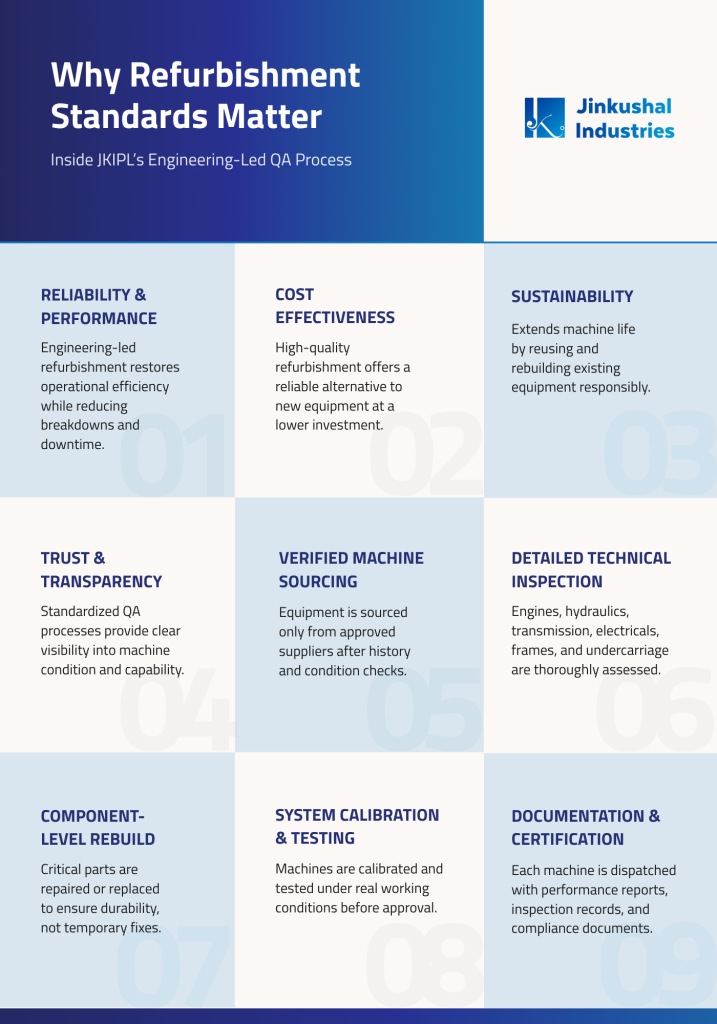
The secondary construction equipment market is continuously growing and is expected to reach $177.2 billion by 2029 and that means the stakes are high. This is why one should stick to the strict standards and why refurbishment is a key demand in the market:
Reliability and performance
The strict standards ensure that the refurbished equipment at least meets the operational quality like in the initial stages, reducing downtime and improving the efficiency for end-users.
Cost-Effectiveness
High-quality refurbishment gives the buyer an affordable alternative to new equipment, especially in this developing market.
Sustainability
Refurbishment of the used construction equipment promotes the reuse of existing machines so that it aligns with the global focus that’s coming on sustainable practices and extending the product life-cycle.
Trust and transparency
A consistent, top-down engineering-led process of QA (Quality Assurance) is what builds trust with customers and delivers transparency about a product’s real condition and what it is expected to do.
JKIPL’s Engineering-Led Refurbishment Process
At JKIPL, all the machines have to go through a controlled refurbished and value enhancement process where systems are inspected, rebuilt, tested, and then certified for future use. Here’s how JKIPL do it:
Step 1: Machine Sourcing & Analysis
All the machines are sourced from verified suppliers, and their service history, usage, and condition are all checked. The machines that meet JKIPL’s standards are the only ones to be further sent for refurbishment.
Step 2: Proper Technical Inspection
A full machine inspection is done on the engines, hydraulics, transmission, electricals, undercarriage, and the frames. This step is done to find out any performance issues there might be or any type of safety concerns you need to watch out for.
Step 3: Component-Level Repair & Replacement
After the inspection is done, key parts like the pumps, seals, hoses, bearings, and engine components are all repaired or replaced. The major focus here is on the durability of the machine, not just the quick fixes.
Step 4: System Integration & Mechanical Calibration
All rebuilt parts are then put back in place, and the machine is then calibrated, hydraulic pressure is set, the engine is tuned, and electrical systems are properly aligned so that it can restore their real performance.
Step 5: Performance & Load Testing
Each machine is tested under real working conditions to check their digging force, lifting power, pressure stability, temperature performance, and braking response. This is done to see if they are performing up to par and any changes are required.
Step 6: Customization & Job-Specific Modifications
In this step, the machines are customized as per the customer needs,which generally includes the attachments, comfort upgrades, climate adaptations, and project-specific setups.
Step 7: Export Ready & Documentation
JKIPL prepares the machines to be ready for export by doing all the required checks, completing export paperwork, and making sure that each of these machines are fitting the international standards.
Step 8: Final QA Certification & Dispatch
Every machine is approved only after passing JKIPL’s internal quality check.
Documentation for Refurbished Construction Equipment
JKIPL makes sure that even after the machine has moved out of the yard the support is continuous. The buyers are given full visibility and the necessary resources that are required to operate, maintain and optimize their refurbished equipment.
Here’s what customers can expect:
Detailed Performance Reports
Every machinery that you buy from JKIPL comes with a performance summary covering engine health, hydraulic pressure range, operating hours, rebuilt components, and load-test results. The reports make buyers know precisely what the machine can achieve from Day 1.
Full Documentation
The customers are provided with the set of the documents in detail:
- Refurbishment checklist
- Component replacement list
- Technical inspection report.
- Export/Compliance papers (with overseas buyers)
- Operation and basic maintenance policies.
This documentation will give transparency and confidence especially in the deployment of the machine for critical projects.
Operation and Usage
There is basic operational guidance to ensure that the teams operate the equipment safely and effectively. In the case of refurbished machines with customization or additions, buyers are provided with unique instructions on how to use the machines to prevent their misuse.
Final Note
In an industry where every single minute of downtime is a loss, refurbishment quality is everything. JKIPL’s approach makes sure that refurbished construction equipment in India is not just affordable, but also reliable and can be used over a long-term prospective value. By working under high standards and accuracy engineering, JKIPL shows how refurbishment when done properly can compete with brand new equipment where it counts- performance and reliability.

