



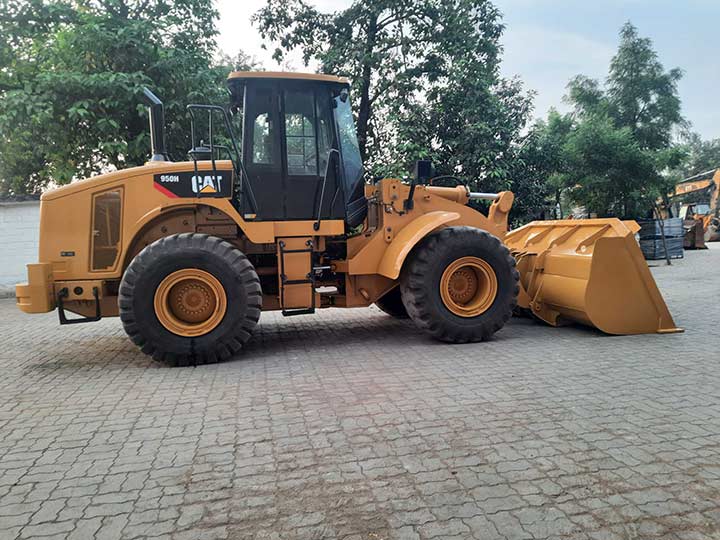
CAT 950H Wheel Loader: Specifications, Bucket Capacity, and Best Use Cases
Wheel loaders or front loaders are primarily designed for loading, unloading and handling heavy materials. Surely, a backhoe loader is similar to this machine, but the prowess you get for handling materials remains unmatched. Combine that with the wheeled design, and we’re looking at moving massive piles of materials quickly across sites. Among used wheel loaders, the CAT 950H is one of the most popular mid-size loaders on the market.
The CAT 950H wheel loader is a mid-size machine built for material handling, loading and stockpile work across quarries, yards and construction sites. It pairs 197 hp of net power with an approximately 18.3-tonne operating weight and a 2.5-3.5 m³ bucket range.
Its planetary powershift transmission is proven Caterpillar technology, which supports its standing as a dependable choice among used wheel loaders. This post covers specifications, wheel loader bucket capacity and practical use cases. You also get a plain reading of what each number means on the job.
Key CAT 950H Specifications At A Glance
There are several reasons why the CAT 950H has remained a popular choice among used wheel loaders. Behind the story are durability, performance, and capabilities. Here are the key features and specifications of the 950H and their significance:
Engine Specs
| Specification | 950H | Why it matters |
|---|---|---|
| Model | Cat C7 ACERT | Proven, rebuildable engine |
| Net power (ISO 9249) | 147 kW (197 hp) | Standard rating buyers compare |
| Gross power (ISO 14396) | 162 kW (217 hp) | Explains why other sites quote a higher hp |
| Peak net torque | 907 Nm at 1,400 rpm | Pulls through the pile |
| Displacement | 7.2 L (bore 110 mm, stroke 127 mm) | Reference size for service and parts |
| Emissions | EPA Tier 3, EU Stage III | Matters for import and compliance checks |
Performance Specs
| Specification | 950H | Why it matters |
|---|---|---|
| Operating weight | 18,320 kg | Stability against transport limits |
| Bucket capacity | 2.5 to 3.5 m³ (max 3.6 m³) | Sets the load per pass |
| Breakout force | 150 kN | Digs compacted material |
| Travel speed | 37 km/h forward, 40 km/h reverse | Faster site repositioning |
| Dump clearance | 2,856 mm (3.1 m³ bucket) | Shows which trucks you can load |
Hydraulic Specs
| Specification | 950H | Why it matters |
|---|---|---|
| Implement pump output | 270 L/min (71 gal/min) | Drives lift and tilt speed |
| Lift (raise) time | 6.2 s | Sets truck-loading pace |
| Dump time | 2.0 s | Fast discharge into the truck |
| Lower time | 2.5 s | Quick return to the pile |
| Float and rack-back time | 2.5 s and 2.7 s | Faster reset between passes |
| Hydraulic tank | 110 L (29 gal) | Reference for oil service and sampling |
| Steering | Load-sensing hydraulic steering | Leaves more power for digging and lifting |
Other Key Specs
| Specification | 950H | Why it matters |
|---|---|---|
| Fuel tank | 264 L | Longer runs between refills |
| Tyre size | 23.5R25 (several tread options) | Affects tyre cost and traction |
| Rear axle oscillation | ±13° | Keeps all four wheels down on rough ground |
| Ground clearance | 397 mm | Handles uneven yards |
| Operator sound level | 72 dB(A) | Less fatigue on long shifts |
| Cab protection | ROPS and FOPS certified | Safety compliance |
CAT 950H Wheel Loader Bucket Capacity Explored & Explained
Your wheel loader bucket decides how many passes fill a truck. A 3.1 m³ bucket in sand or gravel carries approx. 3.6 m³ at the 115% fill factor, so a 14 m³ tipper takes about four passes. Density caps that gain. At 1.5 tonnes per m³, the same load already sits near the 5.4-tonne rated payload.
- General Purpose (2.7, 3.1 or 3.4 m³): Everyday digging in soil, sand and gravel.
- Material Handling (3.2, 3.4 or 3.6 m³): Extra volume for lighter, free-flowing material.
- Rock: Handles blasted stone, where you should plan on a 100% fill factor.
- Multi-Purpose: Doze, clamp and load with one tool on mixed jobs.
- Side Dump: Tips sideways where you cannot turn to load a truck.
- High Dump: Raises the discharge point for tall trucks and hoppers.
- Top Clamp: Grips bulky, awkward loads such as scrap and debris.
- Waste Handling: Suits light, bulky refuse and yard clearing.
- Woodchip: Carries large volumes of light chip and biomass.
CAT 950H Applications
- Quarries: Clear blasted stock and rehandle stockpiles with a rock bucket.
- Truck Loading: A 2.0-second dump and approx. 2.9 m of clearance keep road tippers cycling fast.
- Construction Sites: The CAT 950H moves sand, gravel and soil, then takes pallet forks for site deliveries.
- Plants & Yards: Fill hoppers and bins all shift; the on-demand fan reduces radiator plugging.
- Load & Carry: Optional Ride Control steadies the load over rough ground so you can travel faster.
- Mining Support: Specify L5 tyres for sharp, abrasive rock and stockpile clean-up.
- Road & Civil Work: Backfill, base material and site clean-up without a second machine.
- Timber & Woodchip: Log forks and woodchip buckets cover mill yards.
What to Check Before Buying Used Wheel Loaders
- Hours: Match the meter to service records, since idling inflates the count.
- Engine: Check cold starts, exhaust smoke and pull under load. Ask for oil sampling reports.
- Transmission: Run all four gears both ways and listen for slipping or harsh shifts.
- Hydraulics: Time the raise against 6.2 seconds and check cylinders for leaks. A slow lift can mean pump or valve wear.
- Linkage & Frame: Look for play in Z-bar pins and bushings, and cracks around welds.
- Tyres: Replacing a set costs real money, so check for cuts and uneven wear.
- Machine Identity: Confirm the serial number and model year before you pay a deposit on any CAT 950H.
The CAT 950H earns its place when you need dependable mid-size output without paying for a new machine. Its 150 kN breakout force and 6.2-second lift cover most loading work. Get the wheel loader bucket right and verify hours, hydraulics and linkage before you buy.
Related Articles:
CAT wheel loader or CAT backhoe loader, which one do you need?
Simple maintenance routine to keep a loader working longer
How to reduce material handling costs: 7 practical strategies

