



Types of Earthmoving Equipment and What They’re Used For
Whether it’s a construction project, infrastructure development, mining activity or agriculture, major projects always start with earthmoving. Before a road is created or pillars are erected, sites need to be dug, cleared, levelled, & prepared before each project. Earthmoving equipment is indispensable when it comes to development, maintenance & work in tasks where human labour will otherwise take a huge amount of time.
Knowing the types of earth moving machines saves contractors, site managers, operators & even fleet managers precious time and capital, cutting costs & preventing expensive mistakes on site. This guide explores the most important earthmoving machines used around you, starting with the most common machines, such as excavators & backhoe loaders, to graders, compactors, & dump trucks.
Whether you are buying new or used construction equipment, renting, or planning your next project, this is the starting reference you need.
Most Common Types of Earthmoving Equipment
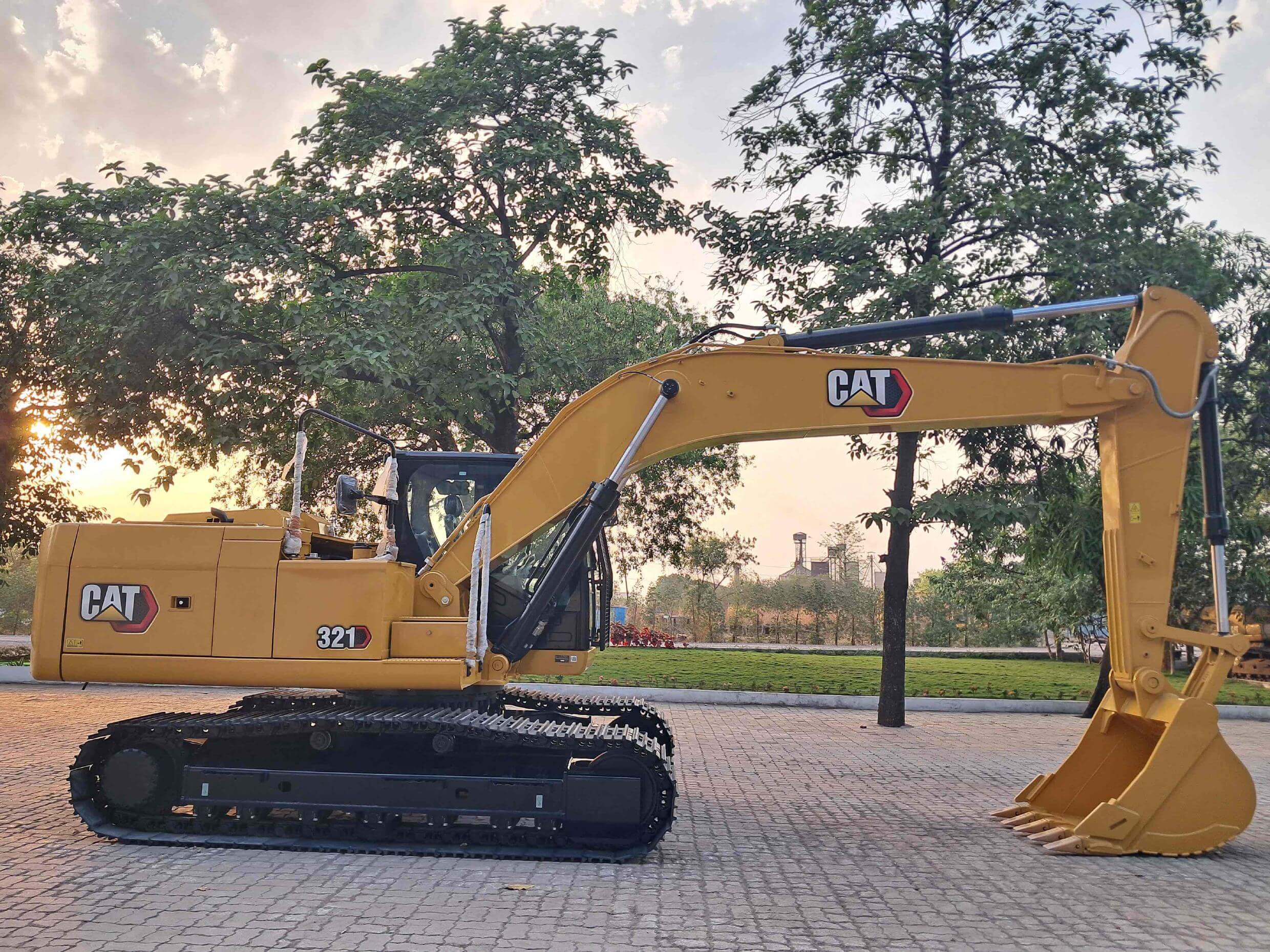
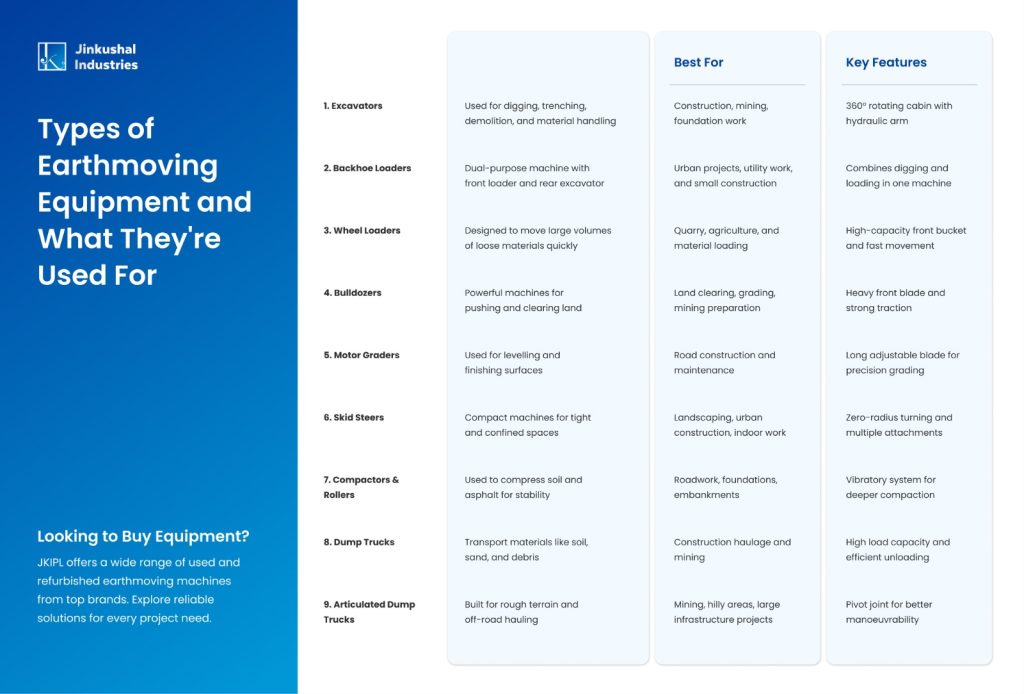
1. Excavators: Often called diggers in some parts of the world, are among the most versatile machines on any job site. They feature a 360° rotating cab fitted on a tracked platform, a hydraulic boom arm, and a front bucket that digs with precision and power.
Excavators can handle several tasks, including trenching, digging, foundation excavations, pipe laying, land clearing, & demolition. In mining, they extract ore & overburden from open pits, while they dig culverts & drainage channels in infrastructure projects. When equipped with the right attachment, like a hydraulic breaker or grapple, an excavator can perform multiple roles in the same project.
2. Backhoe Loaders: Also called TLB machines or tractor backhoes, are the most common types of earth moving machines. However, their extreme popularity is superbly justified. Backhoes are engineered with two arms: the front part comes with a loader arm that can lift & lower, fitted with a bucket for loading, unloading & material handling. The rear has a folding arm, fitted with a smaller bucket for trenching, digging & demolishing.
Backhoe loaders are widely used in road construction, utility installation, landscaping, & small-scale building projects. They are compact enough to operate in urban sites & powerful enough for rural infrastructure tasks. Water supply projects rely heavily on them for pipe trench excavations & pipe laying. Their ability to switch between loading & digging, needing different machines, makes them a cost-effective choice for contractors managing tight budgets.
3. Wheel Loaders: They are designed for offering speed & volume. While they look very similar to backhoe loaders, they only come with the front loader arm & loader bucket. However, on the brighter side, the front arm often provides better lifting height & weight capacity, while the larger standard loader bucket delivers better volume, allowing operators to carry more weight & materials per pass. That’s the reason wheel loaders are also called front loaders.
Their large front bucket scoops up loose materials like soil, sand, gravel, crushed stone, & construction waste, then loads them directly into dump trucks or transport vehicles. Which is why they’re a staple in quarries, aggregate yards, ports, & road construction projects. In agriculture, they move grain, compost, & bulk feed. Their rubber tyres allow fast travel across firm, open ground, making them far more mobile than tracked alternatives.
4. Bulldozers: Dozers are among the most popular types of earth moving machines. They offer the raw power for site preparation. This machine features a wide, heavy front blade that pushes soil, rocks, stumps, & debris across the surface with force that very few machines can match. They are highly useful for land clearing before construction begins, grading rough surfaces, building embankments, & reclaiming mined land.
In road construction, they remove the topsoil & shape the ground before graders take over. In mining, they push waste material to dump areas. Their tracked design gives them heavy traction on steep slopes & loose ground, which makes them the first machine used on most large-scale earthworks projects.
5. Motor Graders: Graders or grading machines are machines built for finishing surfaces. Their long, adjustable blade, fitted between the front & rear axles, levels & smoothens the ground to the required grade.
Motor graders are the primary machine used in road construction for fine grading before asphalt is laid. They are also used to maintain unpaved & gravel roads by redistributing loose material & eliminating ruts. In airport runway construction, motor graders help ensure surface uniformity to recommended levels. Infrastructure projects across mining, irrigation, and urban development all depend on this machine for accurate surface finishing that no other machine can perform with the same consistency.
6. Skid Steers: Skid Steer loaders are small, unique & nimble earthmoving machines, designed to work in tight spaces. They use a unique steering mechanism, where the wheels speed up or slow down on either side to help them turn almost on the same spot. This mechanism makes them extremely useful for urban construction, landscaping, indoor demolition & maintenance & agricultural clean-up.
This machine is also compatible with various attachments like buckets, augers, breakers, forks, etc., allowing one machine to fulfil many tasks.
7. Compactors & Rollers
Compactors and rollers are used to compress soil, gravel, & asphalt to create a stable, load-bearing surface after surface grading. Without proper compaction, roads will crack, and the foundation may shift prematurely.
Single drum compactors are most commonly used on construction sites. They use a heavy front roller to compact soil and base layers & increase surface density in road and earthworks projects.
Vibratory rollers are slightly different. They go a step further by adding mechanical vibration to improve compaction depth on granular surfaces. In highway, dam, & embankment construction projects, getting the optimal density is essential & compactors are the perfect equipment to get that.
8. Dump Trucks: Dump trucks are the backbone of any large earthmoving operation when it comes to haulage operations. They transport excavated soil, rock, sand, demolition waste, raw materials & aggregates between work zones or disposal sites. Without tipper trucks, excavated material would pile up & bring the entire operation to a halt.
Rigid dump trucks carry the heaviest loads in mining & quarrying, often over 100 tonnes per trip. Standard construction dump trucks handle smaller volumes across road and building projects and are widely used. Matching a truck’s capacity to other earthmover output is essential for maintaining a smooth, uninterrupted workflow on high-volume earthmoving sites.
9 Articulated Dump Trucks: Articulated dump trucks are designed for operating in places where traditional trucks cannot operate safely. This truck features a pivot joint that connects the cab to the body. This enables it to bend through the middle & navigate steep slopes, sharp bends, & soft ground without compromising stability.
Articulated trucks are widely used in mining, dam construction, large-scale earthworks, & infrastructure projects in remote or mountainous areas. Their off-road capability, combined with a high payload capacity, makes them a top choice on routes that are rough and unpredictable. For projects where terrain is the biggest challenge, articulated trucks move materials when no other haulier can.
Conclusion
Knowing the types of earth moving machines isn’t about gaining useful knowledge, but offers practical knowledge for fleets & contractors. Buying the right equipment saves money, minimises downtime & helps you keep your project running smoothly.
If you’re looking to buy used & refurbished earthmoving equipment, JKIPL is India’s best dealer. JKIPL offers a large inventory of used machines & refurbished equipment, from the leading manufacturers. Visit our website today to learn more & purchase.

