


Top Mining Equipment Every Contractor Needs for Open-Pit Operations
Open-pit mining outcomes are not only dependent on geology, drilling techniques, or how big your crew is. They’re also highly influenced by fleet composition. If you get your mining equipment mix wrong, the haul cycles come to a halt, project timelines miss deadlines, and fuel and maintenance costs eat your margins. These aren’t hypothetical risks, but what happens on sites where equipment selection was an afterthought, not a strategy.
In this blog, we’ll explore the essential machines for open-pit work and what each one does on site. Whether a fleet is bought new, used or leased short-term, its makeup matters more than the brand name. Let’s get into what actually keeps an open-pit operation running.
What Makes Open-Pit Operations Equipment-Intensive
Open-pit sites don’t use one machine. Digging, loading, hauling, grading and compacting don’t happen at once, across massive pits. That scale separates open-pit work from a typical construction site. Machines here run longer shifts, in tougher terrain, under constant load. Overburden removal alone puts more wear on an excavator in a month than most construction jobs see in a year.
When you add dust, gradient and shifting rock, and downtime becomes the biggest threat to your production targets. Contractors who get this right stop thinking machine by machine and start thinking about the fleet. Every category below plays a role, and skipping one usually means overworking another until it fails.
Excavators: The Backbone
Excavators for mining dig, lift and load, using a hydraulic boom, arm and bucket to cut through overburden and fill haul trucks in a continuous cycle. On an open-pit site, the excavator sets the pace downstream, since haulers only move as fast as they get loaded. Bucket capacity and digging reach matter more than specs.
Undersize one to save cost, and it costs you slower cycles and higher fuel burn. The CAT 320D2 and CAT 330BL excavators handle mid-size loading well, while the CAT 336 and CAT 374 step up for heavier overburden and larger haul fleets.
Dozers
Dozers push, rip and level. A steel blade at the front shifts loose material, while a rear ripper tears into ground excavators can’t touch directly. On open-pit sites, they clear haul roads, strip topsoil, build benches and keep the working face usable as the pit deepens day by day. Without a dozer running ahead of your fleet, every other machine slows down.
Haul trucks hit rough roads, loaders fight uneven ground, and cycle times drift upward without anyone noticing why. Tracked designs provide the necessary traction to operate on steep gradients and highly unstable ground.
CAT D6R dozers are great for lighter grading and road maintenance. The CAT D8 and CAT D8R handle heavy overburden pushing on larger open-pit jobs.
Motor Graders
Motor graders do the fine work dozers can’t. A long blade slung beneath the frame trims and levels haul roads to a precise grade, keeping surfaces smooth enough for loaded trucks to run at speed without shaking apart. In open-pit mining, haul road condition drives everything. A rutted road slows every truck cycle, burns extra fuel, and wears tyres faster than almost anything else.
Graders also cut drainage slopes, so water doesn’t pool and turn haul routes into a mess after rain. The CAT 120 suits smaller sites, the CAT 140K and CAT 140GC handle most mid-size open-pit haul networks, and the 160M takes on the widest, heaviest-traffic roads.
Compaction Equipment
Compaction equipment gets overlooked until a haul road starts sinking under loaded trucks. Vibratory rollers use a steel drum that pulses at high frequency, packing loose soil and rock into a dense base that won’t shift under repeated axle loads.
On open-pit sites, compaction matters most on haul roads, dump pads and equipment laydown areas. Skip it, and you get soft spots that swallow fuel efficiency, slow trucks down, and eventually need rework, costing more than doing it right the first time.
The CASE 1107 EX and Dynapac CC425 rollers cover most soil and rock compaction needs, while a CAT CB13 suits smaller access roads.
Wheel Loaders & Backhoe Loaders
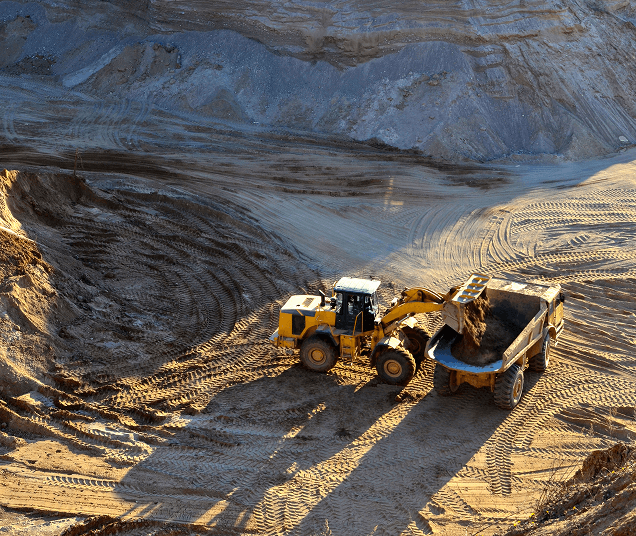
Wheel loaders and backhoe loaders cover jobs excavators aren’t built for. A wheel loader’s front bucket scoops and carries material fast over short distances, feeding crushers, stockpiling ore, or loading trucks when the excavator’s tied up elsewhere. Backhoe loaders combine a front bucket with a rear digging arm, useful for trenching, drainage and utility work around support areas.
On a busy site, these two machines absorb tasks that would otherwise pull your excavator off its main job, keeping the whole cycle moving. CAT 950GC and CAT 966K wheel loaders handle most material handling loads well, and the Case 770EX and Case 570 SV backhoe loaders are proven, versatile all-rounders.
Dump Trucks & Haulers
Dump trucks and haulers move what everything else digs and loads. Rigid haulers carry heavy payloads over fixed haul roads, while articulated trucks pivot at the centre, handling rough or wet terrain a rigid frame can’t manage. Haul cycle time decides your production number. Every minute a truck spends waiting to load, crawling over a bad road, or stuck at the crusher is a minute your pit isn’t moving material, and it adds up fast across a shift.
New vs. Refurbished vs. Used: What Smart Contractors Are Choosing
Buying new isn’t always the smart move. New machines carry a steep upfront cost and a long depreciation curve, and that capital is often better spent elsewhere. Used mining equipment closes that gap. However, it must be closely inspected and serviced properly, not just resold as-is.
Refurbished equipment sits in the middle, and increasingly, that’s where experienced contractors land. A well-refurbished machine delivers close to new-machine reliability at a used-machine price, provided the supplier knows what they’re doing.
Conclusion
Open-pit mining equipment decisions aren’t just procurement line items; they decide whether your production schedule holds or gets delayed. Get the mix right, weigh new against refurbished honestly, and work with a supplier who inspects before it ships. That’s the difference between a fleet that works for you and one that works against you.
Related Reading:
Types of earthmoving equipment and what they are used for
Top 10 uses of excavators across various industries
Motor Graders: What they’re used for and how to buy the right one

